
Introduction
Parenting styles can significantly impact children’s behavior and development. While we are all here parenting, trying the best we possibly can, I have noticed many parents in this generation are confused by social media accounts encouraging what appears to be “permissive parenting” strategies and mislabeling it as “gentle parenting”. Permissive parenting can have troubling consequences for youth as they age into their teenage years and beyond. Gentle parenting should not be confused with it. While they may seem similar at first glance, gentle parenting, and permissive parenting styles have distinct differences and outcomes. This article will compare these two parenting styles and provide tips for parents who wish to embrace gentle parenting without crossing into permissiveness.
What is Gentle Parenting?
Gentle parenting is a modern approach that focuses on nurturing, respect, and emotional support while guiding children’s behavior. It emphasizes understanding children’s feelings and fostering a warm relationship built on trust, empathy, and communication.
Core Principles of Gentle Parenting:
Understanding and Empathy: Recognizing and validating a child’s feelings.
Setting Boundaries: Providing clear guidelines while respecting the child’s autonomy.
Positive Reinforcement: Encouraging good behavior through praise and support.
Modeling Behavior: Demonstrating the behaviors and values you want to instill.
Example of Gentle Parenting: If a child throws a tantrum because they can’t have a cookie before dinner, a gentle parent might kneel down to the child’s level, acknowledge their disappointment, explain why dinner is important, and offer a healthy snack instead.
What is Permissive Parenting?
Permissive parenting is characterized by a lenient, indulgent approach, where parents are more likely to give in to their children’s demands and avoid setting firm boundaries. While permissive parents may have good intentions and want to be friends with their children, this style can lead to issues such as a lack of self-discipline and poor decision-making skills.
Core Characteristics of Permissive Parenting:
Minimal Rules: Few limits on the child’s behavior, allowing them to make most decisions.
Inconsistent Discipline: Rarely enforcing consequences for poor behavior.
Emphasis on Freedom: Overly granting children the freedom to choose without guidance.
Example of Permissive Parenting: If a child insists on eating candy for dinner, a permissive parent might agree, prioritizing their child’s immediate happiness over health or nutrition.
Key Differences Chart:
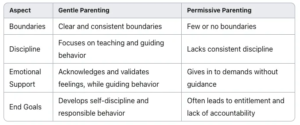
Tips for Implementing Gentle Parenting Without Being Permissive
Establish Clear Boundaries: Set age-appropriate expectations and be consistent in enforcing them. Explain to your child why these rules matter, ensuring they understand the reasoning behind boundaries.
Use Positive Language: Instead of saying what not to do, frame your rules positively. For example, “Let’s use our inside voice,” instead of “Don’t shout.” this does not mean you can not ever say “no”. “No” is an important word to learn to cope with. However, when possible, find the opposite “yes” also. For example “Markers are for coloring on paper. Markers are not for coloring on the table.”
Offer Choices: Empower your child by giving them choices within set limits. For instance, “You can choose between carrots or cucumber slices for a snack.” This encourages independence while maintaining guidance.
Stay Calm During Tantrums: This is easier said then done of course, but all one can do is try! When your child has a meltdown, stay calm and reassuring. Acknowledge their feelings but also gently remind them of the boundaries you’ve established.
Teach Problem-Solving: Instead of just saying “no,” encourage your child to come up with alternatives. For example, if they want to play a video game after school, ask them, “What’s a good time to play, and what else should you finish first?”
Model Self-Regulation: Show your child how to handle emotions by discussing your feelings and demonstrating healthy coping mechanisms. This teaches them to navigate their emotions without resorting to tantrums.
Praise Effort, Not Just Results: Encourage your child’s attempts to follow boundaries and make good choices. This reinforces their desire to behave positively without depending solely on external validation.
Conclusion
Gentle parenting promotes a nurturing approach to raising children while setting necessary boundaries. By being mindful of the differences between gentle and permissive parenting, parents can create a supportive environment that encourages a child’s emotional and social development. Implementing gentle parenting principles thoughtfully will help children develop self-discipline, responsibility, and resilience without falling into permissive habits that could have negative outcomes. Parenting is hard work; no one will get it right daily. We are doing the best we can with the information we have at any given time, and also taking into account our tolerance for frustration and over-stimulation. All we can do is try and remember that each and every day is new! And above all else, we absolutely must take care of ourselves.